Alpha Hydroxy Acid Cream Formulation(eBook PDF)
Alpha Hydroxy Acid Cream Formulation(eBook PDF)
Couldn't load pickup availability

Alpha Hydroxy Acid Cream Formulation(eBook PDF)
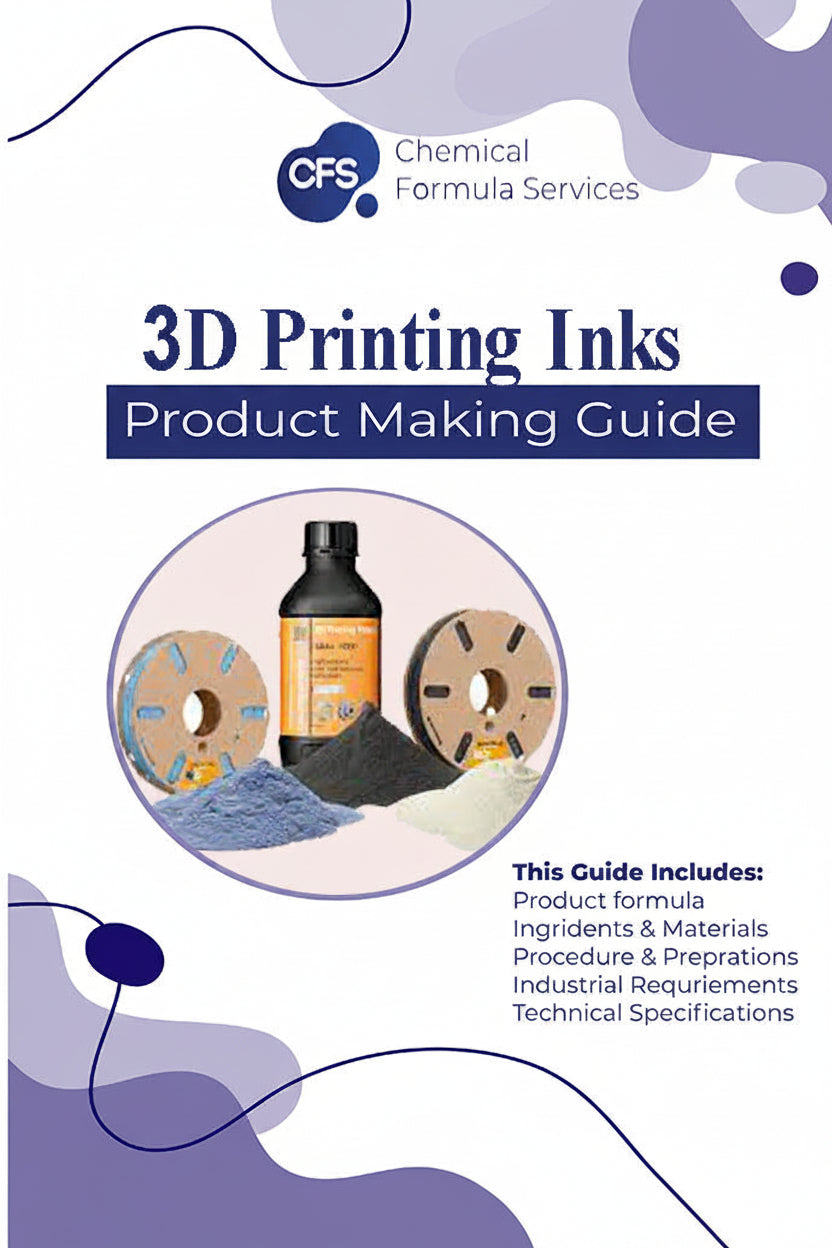
3D Printing Inks Formula - Complete Industrial Guide to 3D Printing Inks Formulation Manufacturing
The additive manufacturing industry has transformed modern production technologies across aerospace, automotive, healthcare, construction, electronics, consumer goods, and industrial manufacturing sectors. At the center of this revolutionary technology is the 3D Printing Inks Formula, an advanced materials system specifically engineered to create precise, durable, and high-performance three-dimensional printed objects layer by layer.
A professionally developed 3D Printing Inks Formulation combines polymers, photopolymers, pigments, dispersing agents, rheology modifiers, conductive materials, ceramic particles, metallic powders, stabilizers, and specialty additives to produce functional printing materials suitable for multiple 3D printing technologies. These technologies include fused deposition modeling (FDM), stereolithography (SLA), digital light processing (DLP), direct ink writing (DIW), binder jetting, selective laser sintering (SLS), and bioprinting applications.
At Chemical Formula Services, we provide advanced Chemical Formulation Services for industrial manufacturers, additive manufacturing companies, polymer developers, and entrepreneurs entering the rapidly expanding 3D printing materials industry. Our expert Formulation Chemist teams and highly experienced Formulation Scientist professionals specialize in advanced Formulation Development solutions for innovative 3D printing technologies using scalable and efficient Formulation Factory manufacturing systems.
This comprehensive ebook description explores the chemistry, ingredients, manufacturing technologies, industrial applications, troubleshooting methods, production systems, commercial opportunities, and future innovations associated with modern 3D printing ink technologies.
What is 3D Printing Inks Formula?
A 3D Printing Inks Formula is a specially engineered material system used in additive manufacturing processes to create three-dimensional objects through controlled layer-by-layer deposition or curing techniques.
These formulations are designed to provide:
- Controlled viscosity
- Print stability
- Layer adhesion
- Mechanical strength
- Dimensional accuracy
- Thermal stability
- Surface quality
- Chemical resistance
- Conductivity
- Biocompatibility
A professionally engineered 3D Printing Inks Formulation may contain:
- Thermoplastic polymers
- Photopolymer resins
- Pigments
- Ceramic particles
- Metallic powders
- Conductive fillers
- UV initiators
- Rheology modifiers
- Stabilizers
- Plasticizers
- Solvents
- Dispersing agents
These ingredients work together to create highly specialized printable materials optimized for various additive manufacturing technologies and industrial applications.
Importance of 3D Printing Inks in Modern Manufacturing
3D printing materials have become essential in modern industrial innovation and rapid manufacturing systems.
Rapid Prototyping
3D printing enables fast product design validation and prototype development.
Customized Manufacturing
The technology supports highly customized and personalized product creation.
Reduced Material Waste
Additive manufacturing minimizes waste compared to traditional machining methods.
Complex Geometry Production
Advanced formulations enable the creation of highly complex structures.
Lightweight Engineering
3D printing materials support lightweight and high-strength component production.
Accelerated Product Development
Manufacturers can reduce development cycles and improve innovation speed.
Key Components of 3D Printing Inks Formulation
Developing a high-performance 3D Printing Inks Formula requires advanced materials science expertise and precise ingredient balancing. A skilled Formulation Chemist carefully optimizes rheology, curing behavior, particle dispersion, printability, and final mechanical performance.
Thermoplastic Polymers
Thermoplastic materials are commonly used in filament-based 3D printing systems.
Common polymers include:
- PLA
- ABS
- PETG
- Nylon
- TPU
- Polycarbonate
These materials provide:
- Structural strength
- Flexibility
- Printability
- Durability
Photopolymer Resins
Photopolymer systems cure through UV light exposure in SLA and DLP technologies.
These resins provide:
- High precision
- Smooth surface finish
- Fine detail reproduction
Metallic Powders
Metal powders are used in aerospace, automotive, and medical additive manufacturing applications.
Common metals include:
- Stainless steel
- Titanium
- Aluminum
- Cobalt-chrome alloys
Ceramic Materials
Ceramic-based inks provide heat resistance and electrical insulation properties.
Conductive Fillers
Conductive materials allow the production of electronic circuits and smart components.
Common conductive fillers include:
- Carbon nanotubes
- Graphene
- Silver particles
- Copper powders
Rheology Modifiers
Rheology additives control flow behavior and print stability.
UV Initiators
Photoinitiators enable rapid curing in UV-based printing technologies.
Stabilizers
Thermal and UV stabilizers improve storage stability and printing performance.
Dispersing Agents
Dispersants ensure uniform particle distribution throughout the formulation.
Important Characteristics of 3D Printing Inks Formula
A professionally engineered 3D Printing Inks Formulation should provide exceptional print quality, process stability, and mechanical performance.
Controlled Viscosity
The formulation must maintain proper flow behavior during printing.
Excellent Layer Adhesion
Each printed layer should bond strongly to adjacent layers.
High Dimensional Accuracy
The printed object should retain precise geometry and tolerances.
Thermal Stability
Materials should withstand printing temperatures without degradation.
Mechanical Strength
The final product should provide durability and structural integrity.
Surface Quality
Premium formulations produce smooth and visually appealing surfaces.
Chemical Resistance
Certain applications require resistance to chemicals and solvents.
UV Stability
Outdoor applications require protection against UV degradation.
Types of 3D Printing Inks Formulation
Different additive manufacturing technologies require specialized material systems developed through advanced Formulation Development processes.
FDM Filament Formulation
Thermoplastic materials designed for fused deposition modeling printers.
SLA Resin Formulation
UV-curable photopolymer systems for stereolithography applications.
Conductive Printing Ink
Specialized formulations for printed electronics and wearable devices.
Ceramic Printing Ink
High-temperature resistant materials for industrial and artistic applications.
Metal Printing Powder Systems
Advanced metallic materials for aerospace and medical manufacturing.
Bioprinting Ink Formulation
Biocompatible materials used in tissue engineering and medical research.
Flexible Elastomeric Printing Ink
Rubber-like materials for flexible products and wearable technologies.
Industrial and Commercial Applications of 3D Printing Inks
A professionally developed 3D Printing Inks Formula serves numerous advanced manufacturing industries.
Aerospace Industry
3D printing produces lightweight aircraft components and structural parts.
Automotive Industry
Manufacturers create prototypes, customized parts, and performance components.
Healthcare Industry
Medical applications include implants, prosthetics, dental devices, and surgical models.
Electronics Industry
Conductive inks support printed circuits and smart electronic devices.
Construction Industry
Large-scale additive manufacturing supports architectural and construction innovations.
Consumer Products Industry
Customized consumer goods and limited-edition products utilize 3D printing technology.
Fashion and Jewelry Industry
Complex decorative and wearable designs are produced using advanced printing materials.
Manufacturing Process of 3D Printing Inks
Producing high-quality 3D Printing Inks Formulation products requires precision manufacturing systems and strict quality control procedures.
Raw Material Selection
High-purity polymers, additives, and fillers are selected for optimized performance.
Particle Dispersion
Powders and pigments are uniformly dispersed using industrial mixing systems.
Polymer Blending
Base polymers are blended with modifiers and stabilizers.
Rheology Optimization
Flow properties are adjusted to achieve ideal printing behavior.
Filtration Process
Fine filtration removes contaminants and agglomerates.
Degassing
Vacuum processing eliminates trapped air bubbles.
Quality Testing
Final materials undergo testing for:
- Viscosity
- Printability
- Mechanical strength
- Thermal resistance
- Particle size distribution
- Cure speed
- Surface finish
- Dimensional stability
Packaging
Products are packaged under controlled environmental conditions to maintain quality and stability.
Common Troubleshooting Issues in 3D Printing Ink Manufacturing
An experienced Formulation Scientist understands the importance of solving manufacturing and printing challenges during additive manufacturing material production.
Poor Layer Adhesion
Improper polymer compatibility may weaken interlayer bonding.
Nozzle Clogging
Large particles or poor dispersion may block printer nozzles.
Warping and Shrinkage
Thermal instability may cause dimensional deformation.
Bubble Formation
Entrapped air may reduce print quality and structural integrity.
Inconsistent Viscosity
Improper rheology balancing may affect print consistency.
Sedimentation Problems
Heavy fillers may settle during storage without proper stabilization.
UV Cure Failure
Incorrect photoinitiator systems may reduce curing efficiency.
Surface Defects
Poor flow behavior may create rough or uneven surfaces.
Business Opportunities in 3D Printing Inks Manufacturing
The additive manufacturing industry offers substantial growth opportunities for entrepreneurs and industrial manufacturers.
Industrial Material Manufacturing
Demand for advanced printing materials continues expanding globally.
Private Label Production
Many brands seek customized 3D printing material solutions.
Medical Printing Applications
Healthcare sectors require specialized biocompatible materials.
Electronics Printing Industry
Printed electronics represent a rapidly growing market segment.
Research and Development Services
Universities and research institutions require advanced material development support.
Role of Chemical Formula Services in Formulation Development
Chemical Formula Services provides advanced Chemical Formulation Services for additive manufacturing companies and material developers worldwide. Our experienced Formulation Scientist teams and expert Formulation Chemist professionals specialize in customized Formulation Development solutions for high-performance 3D printing materials.
Our services include:
- Custom 3D printing ink formulation
- Polymer system optimization
- Rheology control development
- Conductive material formulation
- UV curing optimization
- Stability testing
- Manufacturing process guidance
- Scale-up support
As a professional Formulation Factory, we help businesses create reliable, scalable, and commercially competitive additive manufacturing materials.
Future Trends in 3D Printing Inks Formulation
The additive manufacturing industry continues evolving through advanced material science, sustainability, and smart manufacturing technologies.
Biodegradable Printing Materials
Eco-friendly polymers and sustainable printing systems are becoming increasingly important.
Smart Functional Materials
Future materials may include self-healing, conductive, or responsive technologies.
Multi-Material Printing Systems
Advanced printers can combine multiple materials within a single printed object.
High-Speed Industrial Printing
Improved formulations support faster production and large-scale manufacturing.
Advanced Medical Bioprinting
Biocompatible inks continue advancing regenerative medicine applications.
Why Professional Formulation Development Matters
Developing a successful 3D Printing Inks Formula requires advanced polymer science expertise, industrial manufacturing knowledge, and precise rheological control. Professional Chemical Formulation Services help manufacturers improve material performance, reduce printing defects, and accelerate commercial success.
An experienced Formulation Scientist understands additive manufacturing technologies, polymer interactions, filler dispersion, curing systems, and industrial production requirements. Likewise, a skilled Formulation Chemist ensures proper printability, mechanical performance, stability, and scalable manufacturing consistency.
At Chemical Formula Services, we combine scientific innovation, advanced Formulation Development, and industrial manufacturing expertise to create premium additive manufacturing materials for modern industrial applications.
The importance of a professionally engineered 3D Printing Inks Formula continues to grow as industries increasingly adopt additive manufacturing technologies for rapid prototyping, customized production, lightweight engineering, and advanced industrial innovation. A high-performance 3D Printing Inks Formulation provides exceptional print quality, dimensional accuracy, mechanical durability, and process reliability for modern manufacturing systems.
As global demand for advanced additive manufacturing materials expands, businesses increasingly require innovative products developed through expert Chemical Formulation Services, experienced Formulation Chemist expertise, and advanced Formulation Scientist research. With scalable Formulation Factory production systems and strategic Formulation Development, manufacturers can successfully produce competitive 3D printing materials for local and international markets.