Automotive Paint Thinner Formula(eBook PDF)
Automotive Paint Thinner Formula(eBook PDF)
Couldn't load pickup availability

Automotive Paint Thinner Formula(eBook PDF)
Austenitizing Salt Bath Formulation - Complete Product Making Guide of Austenitizing Salt Bath Formula Manufacturing for Startups, Established Businesses, and Manufacturers
Austenitizing Salt Bath Formulation (Austenitizing Salt Bath Formulat)
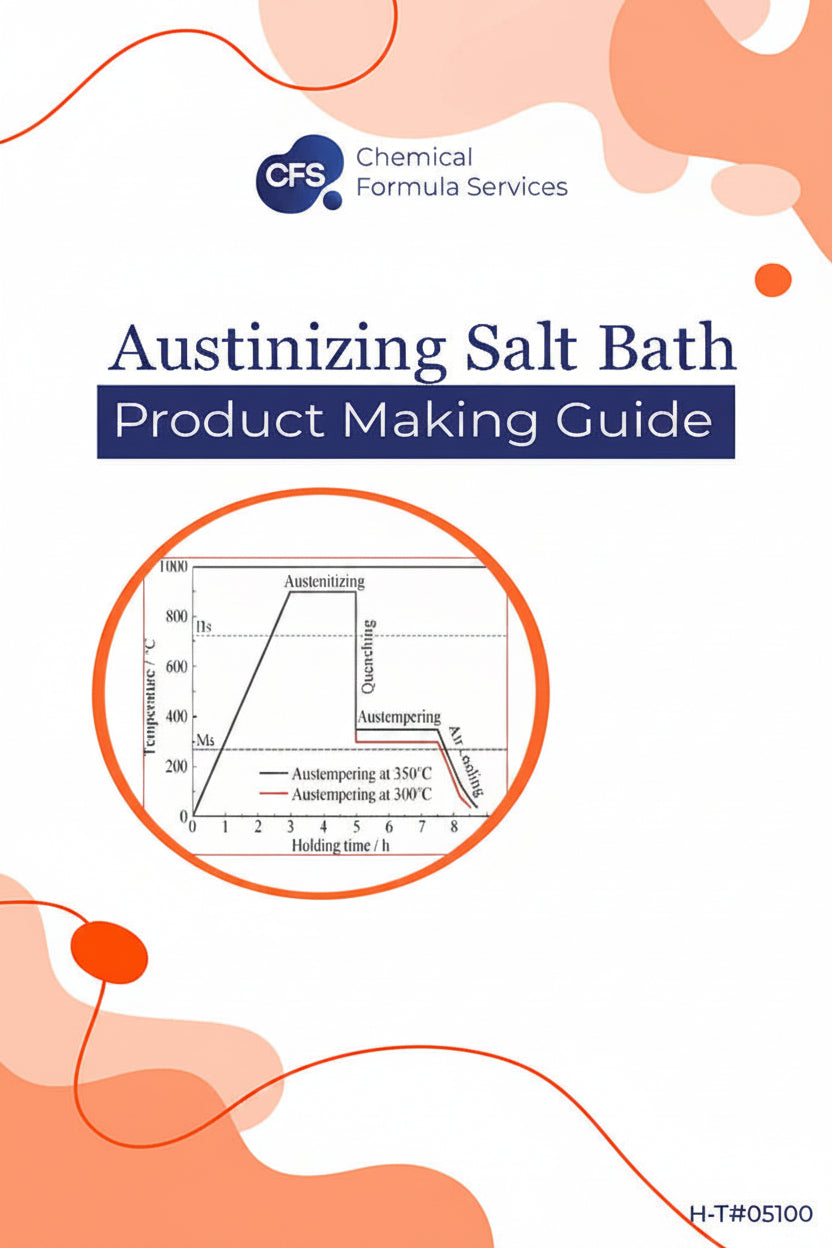
Austenitizing Salt Bath Formulation is the process of heating steel to a temperature above its critical transformation temperature using a molten salt medium. This temperature varies depending on the specific steel composition. By heating the steel within this range, the microstructure transforms into austenite, a solid solution of iron and carbon. The Austenitizing Salt Bath Formulation, developed under Chemical Formula Services, is designed to ensure uniform heating, controlled phase transformation, and consistent metallurgical results.
This system is further enhanced through Chemical Formulation Services and advanced Formulation Development, ensuring industrial-grade precision in heat treatment applications. The process is guided by a professional Formulation Chemist, executed in a controlled Formulation Factory, and validated by a Formulation Scientist to ensure stability, safety, and repeatable performance.
Purpose and Metallurgical Function
Austenitizing is typically performed to prepare steel for subsequent heat treatment steps such as quenching and tempering. The goal is to dissolve carbides or other precipitates present in the steel and obtain a fully austenitic structure. This transformation enables improved hardness, strength, and toughness after heat treatment.
These metallurgical transformations are optimized under Chemical Formula Services and refined through Chemical Formulation Services to ensure consistent thermal behavior across different steel grades.
Salt Bath Processing and Chemical Considerations
A salt bath for austenitizing is also used for tempering structural parts made of iron and steel treated in cyanide-free or low-cyanide nitriding salt baths or other cyanide-containing salt baths. This process is useful when components have previously been treated in carburization or cyanide-containing environments.
The Austenitizing Salt Bath Formulation ensures controlled oxidation and safe breakdown of residual cyanide compounds, preventing hazardous reactions. These systems are developed through structured Formulation Development, guided by a Formulation Chemist, and produced in a controlled Formulation Factory environment.
The cyanide content in salt baths used for austenitization or carburization is typically limited to about 10% by weight (calculated as NaCN) to avoid unstable reactions between nitrate-containing and cyanide-containing salts. A Formulation Scientist ensures chemical stability and process safety validation.
Austenitizing Temperature, Soaking & Quenching
The exact austenitizing temperature and soaking time depend on the steel grade and desired mechanical properties. It is essential to follow manufacturer recommendations or established industrial guidelines.
During processing, steel is held at the austenitizing temperature for a defined period to ensure uniform transformation. After soaking, it is rapidly cooled (quenched) in oil, water, or air to lock in the austenitic structure.
These heat treatment parameters are optimized under Chemical Formula Services and refined using Chemical Formulation Services to ensure repeatable metallurgical outcomes.
Following quenching, additional heat treatment such as tempering may be applied by reheating the steel to a lower temperature to achieve the desired balance of hardness, strength, and toughness.
Heat Treatment Salt Bath Composition
The heat treatment process, including Austenitizing Salt Bath Formulation, significantly influences the mechanical properties and performance of steel. Therefore, process control is critical.
Advanced Formulation Development ensures consistent salt bath composition, while a Formulation Chemist manages chemical stability and operational safety. Production scaling is handled in a Formulation Factory, and final performance validation is conducted by a Formulation Scientist.
These systems are fully supported by Chemical Formula Services and Chemical Formulation Services to ensure industrial reliability and metallurgical precision.
Final Technical Recommendation
It is recommended to consult a qualified metallurgist or heat treatment professional to ensure correct procedures and parameters are followed for specific steel alloys and applications. Proper control of the Austenitizing Salt Bath Formulation ensures optimal mechanical performance and safe industrial operation.