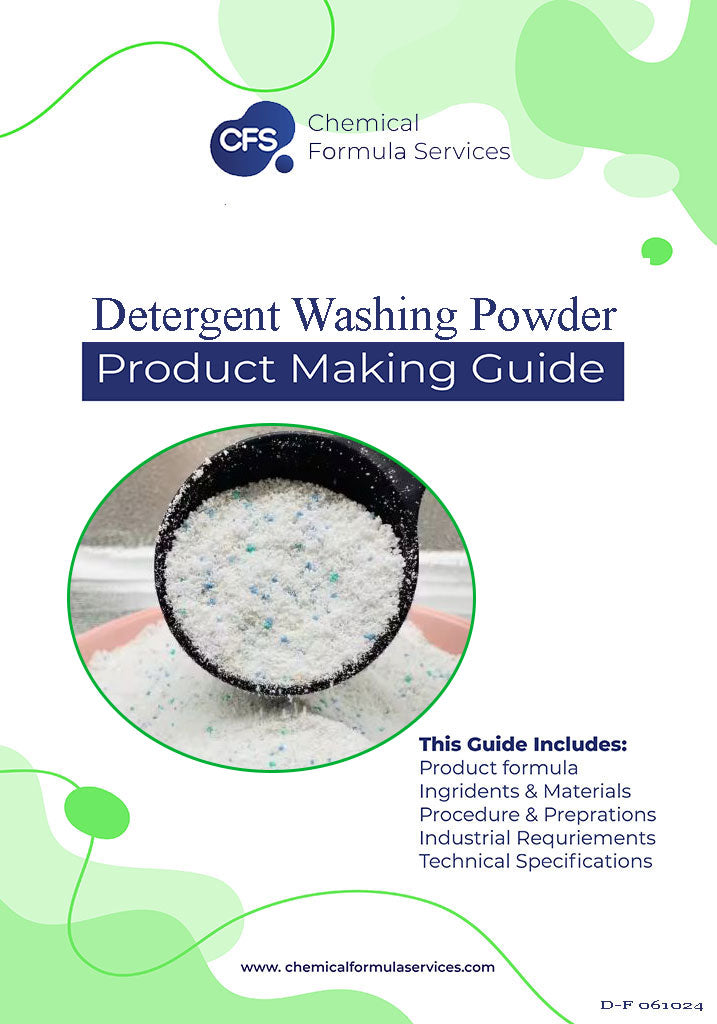
Detergent Washing Powder Formula
Detergent Washing Powder Formula
Regular price
$65.00
Regular price
$65.00
Sale price
Unit price
per
Couldn't load pickup availability

Detergent Washing Powder Formula
Regular price
$65.00
Regular price
$65.00
Sale price
Unit price
per
\n
\n
\n
\n
\n
\n
\n
\n
\n
\n
\nDetergent powder formulaÊ can vary significantly depending on the specific brand and type of detergent. A general list of common detergent powder ingredients found in many laundry detergent powders formulation
\n
\nDetergent powder ingredients
\n-
\n
- Surfactants: These are the primary cleaning agents in detergent powder formula . Common surfactants include:
\n
-
\n
- Sodium lauryl sulfate (SLS) \n
- Sodium laureth sulfate (SLES) \n
- Alkylbenzene sulfonates (LAS) \n
- Alcohol ethoxylates \n
\n - Builders: Builders are used to soften water and enhance the effectiveness of the surfactants. Common builders include:
\n
-
\n
- Sodium carbonate (soda ash) \n
- Sodium tripolyphosphate (STPP) \n
- Sodium silicate \n
- Zeolites \n
\n - Bleaching Agents: These detergent ingredients help to remove stains and whiten clothes:
\n
-
\n
- Sodium percarbonate (oxygen bleach) \n
- Sodium perborate \n
- Enzymes (protease, amylase, lipase, etc.) \n
\n - Fillers and Binders: These substances are used to bulk up the detergent powder formula and hold it together:
\n
-
\n
- Sodium sulfate \n
- Sodium chloride (table salt) \n
- Carboxymethylcellulose (CMC) \n
\n
Other content of the formula
\n-
\n
- Fragrances: Fragrances are added to provide a pleasant scent to the detergent formula. \n
- Optical Brighteners: These compounds make clothes appear brighter and whiter by absorbing UV light and re-emitting it as visible blue light. \n
- Stabilizers and Anti-redeposition Agents: These help prevent soil and stains from settling back onto the fabric during washing. \n
- Dyes and Colorants: These are added for aesthetic purposes to give the detergent formulation its color. \n
- Antifoaming Agents: These prevent excessive foaming during the washing process. \n
- Other Additives: Some detergents may contain additional additives for specific purposes because it is usedÊ as stain removers, fabric softeners, or anti-microbial agents. \n
DetergentÊ making business
\nStarting a detergent powder making business can be a profitable venture. \n \nResearch and Planning: \n-
\n
-
\n
-
\n
- Study the market demand and competition in your area. \n
- Identify your target market, such as households, commercial establishments, or both. \n
- Determine the types of detergent powder you want to produce, such as laundry detergent, dishwashing detergent, or specialty detergents. \n
- Analyze the production process, ingredients, and equipment required. \n
\n -
Business Plan:
\n
-
\n
- Create a comprehensive business plan outlining your objectives, target market, marketing strategy, production process, financial projections, and legal requirements. \n
- Determine your startup costs, including equipment, raw materials, packaging, and marketing expenses because it is necessary. \n
- Explore potential funding options if needed. \n
\n -
Legal Requirements:
\n
-
\n
- Register your business and obtain necessary licenses and permits from local authorities. \n
- Comply with health and safety regulations and any specific regulations because it must be related to detergent manufacturing. \n
\n -
Location and Infrastructure:
\n
-
\n
- Find a suitable location for your production facility. Consider factors like accessibility, space requirements, utilities, and storage facilities. \n
- Set up the necessary infrastructure, including production area, storage area, packaging area, and office space. \n
\n
Detergent powder Equipment and Raw Materials
\n-
\n
-
\n
-
\n
- Purchase the required equipment for detergent powder production, such as mixers, grinders, and packaging machines. Consider the capacity and efficiency of the equipment based on your production volume. \n
- Source high-quality raw materials, including surfactants, builders, fillers, fragrances, and packaging materials. Establish relationships with reliable suppliers. \n
\n -
Production Process:
\n
-
\n
- Develop a standardized detergent powder production process. This may involve mixing and blending ingredients, granulation, drying, and packaging. \n
- Ensure strict quality control measures at every stage to maintain consistency and meet industry standards. \n
\n -
Packaging and Branding:
\n
-
\n
- Design attractive packaging for your detergent powder products. Consider convenience, durability, and branding elements like logos, labels, and product information. \n
- Create a brand name and logo that resonates with your target market. Develop a marketing strategy to promote your brand and differentiate it from competitors. \n
\n -
Distribution and Marketing:
\n
-
\n
- Establish distribution channels to reach your target market. This can include wholesalers, retailers, or direct sales to consumers. \n
- Develop marketing and promotional strategies, such as advertising, online presence, product demonstrations, and discounts. \n
- Build relationships with potential customers and offer excellent customer service. \n
\n -
Compliance and Quality Control:
\n
-
\n
- Adhere to regulatory standards and guidelines for detergent manufacturing, labeling, and safety. \n
- Implement quality control measures to ensure consistent product qualityÊ but to perform a regular testing and analysis to meet customer expectations. \n
\n -
Business Growth:
\n
-
\n
- Continuously monitor the market trends, customer feedback, and competition to adapt and improve your product offerings. \n
- Explore opportunities for product diversification, expanding into new markets, or introducing eco-friendly or specialized detergent products. \n
\n