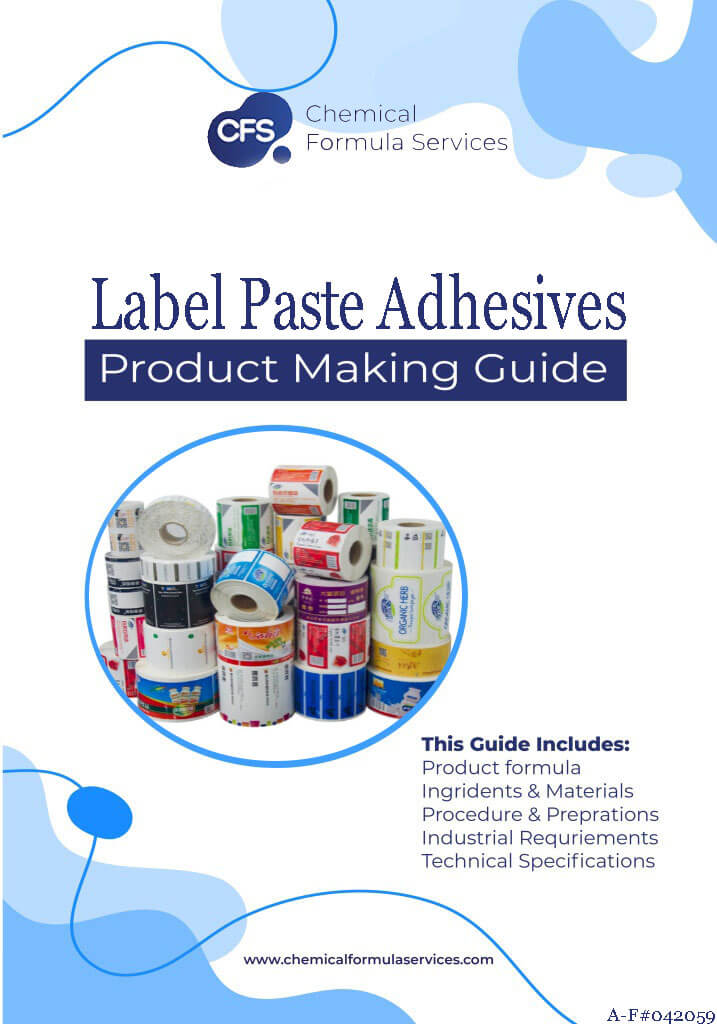
Label Paste Adhesives Formula
Label Paste Adhesives Formula
Regular price
$50.00
Regular price
$50.00
Sale price
Unit price
per
Couldn't load pickup availability

Label Paste Adhesives Formula
Regular price
$50.00
Regular price
$50.00
Sale price
Unit price
per
Label Paste Adhesives Formula is specialized adhesives used for attaching labels to various surfaces. These adhesives are designed to provide strong bonding and ensure that labels remain securely attached for extended periods. Label paste adhesives typically come in a paste or gel-like form and are applied directly to the back of the label before it is affixed to the desired surface.
\n
View full details
Types of label paste Adhesives
\n-
\n
- Water-based adhesives:ÊThese adhesives are formulated with water as the main solvent. They are environmentally friendly and have low toxicity. Water-based adhesives are easy to apply, dry quickly, and offer good adhesion to a wide range of surfaces. \n
- Solvent-based adhesives:ÊSolvent-based label paste adhesives use organic solvents as the primary carrier. They provide excellent adhesion to different surfaces, including non-porous materials. Solvent-based adhesives have a fast drying time and offer high initial tack, making them suitable for applications where quick bonding is required. \n
- Hot melt adhesives:ÊHot melt label paste adhesives are thermoplastic adhesives that are heated to a molten state for application. They are typically used in high-speed labeling applications where rapid bonding and immediate handling strength are necessary. Hot melt adhesives provide strong adhesion to various surfaces and have a quick setting time. \n
- Pressure-sensitive adhesives (PSAs):ÊPSAs are a type of label paste adhesive that forms an instant bond when light pressure is applied. They do not require heat, water, or solvents for activation. PSAs offer excellent adhesion to a wide range of surfaces, including paper, plastic, glass, and metal. They provide easy application and can be removed without leaving behind residue or damaging the surface. \n
Sticker adhesive ingredients
\nThe ingredients of sticker adhesive can vary depending on the type of adhesive used for the stickers. \n-
\n
-
Pressure-Sensitive Adhesive (PSA) Stickers (such as vinyl stickers):
\n
-
\n
- Acrylic adhesive: This type of adhesive is often used in PSA stickers. It consists of acrylic polymers and various additives. \n
- Liner or backing material: This is usually a paper or plastic material that protects the adhesive until the sticker is applied. \n
\n -
Rubber-based Adhesive Stickers (such as some tape-style stickers):
\n
-
\n
- Natural or synthetic rubber adhesive: Rubber-based adhesives contain rubber polymers and tackifiers to provide a strong bond. \n
- Liner or backing material: Similar to PSA stickers, rubber-based adhesive stickers have a protective liner or backing. \n
\n -
Heat-Activated Adhesive Stickers (such as iron-on patches):
\n
-
\n
- Heat-activated adhesive: These adhesives are designed to melt and bond with the fabric when heat is applied. \n
- Fabric or backing material: Iron-on patches typically have a fabric or backing material to which the adhesive is applied. \n
\n -
Gummed Paper Labels (moisture-activated adhesive):
\n
-
\n
- Starch-based adhesive: These labels are activated by moisture, typically water. The adhesive is often made from starch or dextrin. \n
- Paper label: The adhesive applies on a paper label. \n
\n -
Removable Adhesive Stickers:
\n
-
\n
- Removable adhesive: These adhesives are less aggressive and are designed in such a way toÊ easily remove without leaving residue. \n
- Liner or backing material: Removable stickers have a backing material similar to other PSA stickers. \n
\n -
Specialty Adhesives (such as holographic or metallic stickers):
\n
-
\n
- These may contain unique adhesive formulations for specific visual or functional effects. \n
\n
Troubleshootin label paste adhesives products
\nWhen producing label paste adhesives, manufacturers may encounter various issues that can affect product quality, consistency, and effectiveness. \n-
\n
- Inadequate Viscosity \n
-
\n
- Poor Adhesion \n
-
\n
- Excessive Foaming \n
-
\n
- Uneven Application \n
-
\n
- Premature Setting or Curing \n
-
\n
- e upon Removal \n
-
\n
- Color Inconsistency \n
-
\n
- Chemical Stability Issues \n