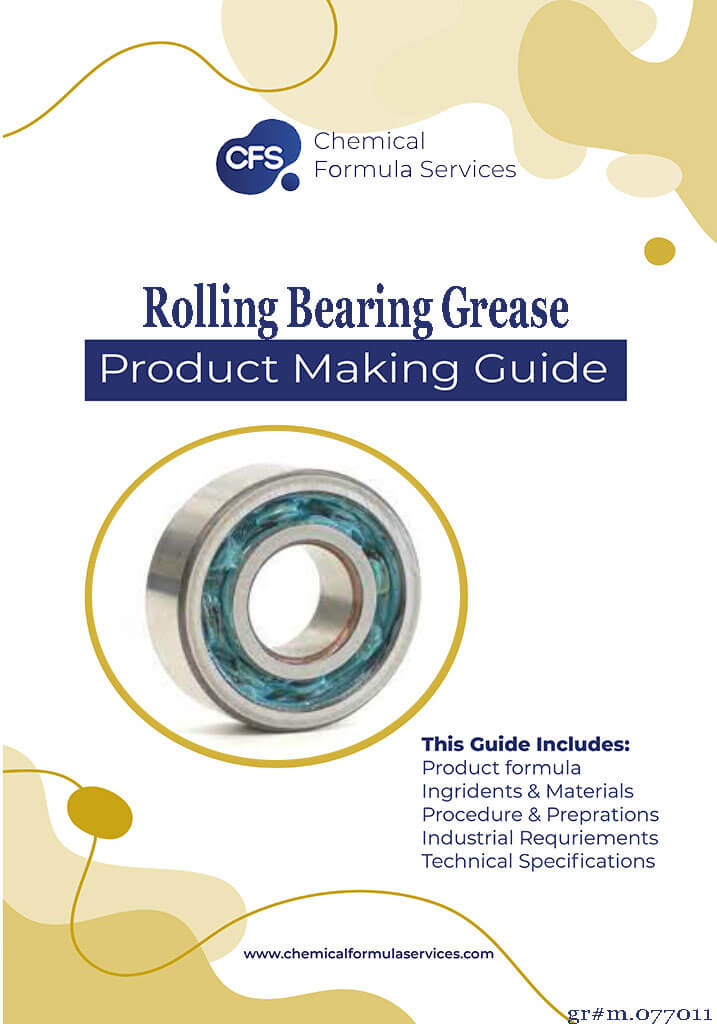
Rolling Bearing Grease Formulation
Rolling Bearing Grease Formulation
Regular price
$75.00
Regular price
$75.00
Sale price
Unit price
per
Couldn't load pickup availability

Rolling Bearing Grease Formulation
Regular price
$75.00
Regular price
$75.00
Sale price
Unit price
per
Rolling bearing grease formula is a specific type of lubricant designed to provide effective lubrication and protection for rolling bearings. Rolling bearings, also known as ball bearings or roller bearings, are widely used in various applications to support and enable smooth rotational movement between two or more components.
\n
View full details
Grease making ingredients
\n
\n
\n
\n
\n
\n
\n
\n
\n
\n
\n
\n
\n
\n
\n
\n
\n
\n
\n
\n-
\n
- Base Oil: Rolling bearing greases typically use mineral oil or synthetic oil as the base fluid. Mineral oil provides good lubrication properties at lower operating temperatures, while synthetic oils offer enhanced performance at high temperatures and under extreme conditions. \n
- Thickeners: Greases are thickened with additives called thickeners to give them a semi-solid consistency. Common thickeners used in rolling bearing greases include lithium, lithium complex, calcium complex, or aluminum complex. These thickeners provide structure and retain the oil within the grease to ensure it stays in place and provides lubrication over an extended period. \n
- Additives: Rolling bearing greases often contain various additives to enhance their performance. These additives can include anti-wear agents, extreme pressure (EP) additives, rust and corrosion inhibitors, antioxidants, and anti-foaming agents. The selection and concentration of additives depend on the specific application and the expected operating conditions. \n
- NLGI Grade: Greases are classified according to the National Lubricating Grease Institute (NLGI) grade, which indicates their consistency. Rolling bearing greases typically fall within the NLGI grades 1 to 3, with grade 2 being the most common for general-purpose applications. \n
- Operating Conditions: When selecting a rolling bearing grease, it is essential to consider the operating conditions such as temperature, speed, load, and environmental factors. Different applications may require greases with specific properties, such as high-temperature resistance, low noise generation, water resistance, or resistance to extreme pressures. \n
- Compatibility: In the making of a rolling bearing greaseÊ which is compatible with the materials is used in the bearings, seals, and other components. Incompatible greases can cause damage to the bearing surfaces or affect the performance and service life of the bearing. \n
Rolling bearing grease formula product guide
\nThe choice of making the rolling bearing grease depends on factors such as the raw material, processing marketing along with its application .There are so manyÊ requirements, operating conditions, equipment manufacturer recommendations, and industry standards requires. Consulting with CFS lubricant expertsÊ or following the manufacturer's guidelines is advisable to ensure the correct selection and application of rolling bearing grease. \n \nThis book is ideal for: \n-
\n
- Lubricant formulators looking to develop advanced grease formulations. \n
- Chemical engineers and tribologists working in grease manufacturing. \n
- Maintenance professionals and mechanical engineers responsible for bearing lubrication. \n
- Researchers and students in the field of lubrication science and tribology. \n