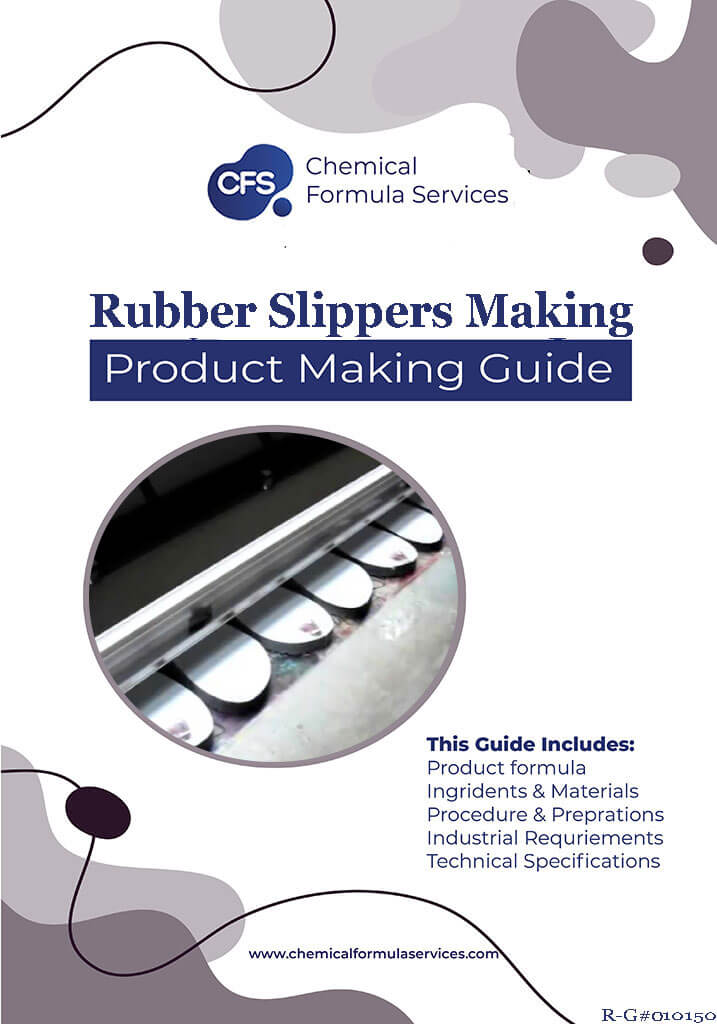
Rubber Slippers Formulation
Rubber Slippers Formulation
Regular price
$70.00
Regular price
$70.00
Sale price
Unit price
per
Couldn't load pickup availability

Rubber Slippers Formulation
Regular price
$70.00
Regular price
$70.00
Sale price
Unit price
per
Rubber slippers formulation, also known as flip-flops or thong sandals, typically involves a manufacturing process that includes the following steps:
\n
View full details
Rubber Slippers Material Preparation
\nSheet rubber : The primary material used for the sole of rubber slippers is rubber sheets. These sheets are usually made from natural rubber or synthetic rubber compounds. \nStraps: The straps of the slippers are often made from a flexible and durable material such as rubber or synthetic materials like PVC or polyurethane. These materials are cut into strips or shaped into straps. \nCutting and Shaping:
\nSole Cutting: The rubber sheets are cut into the desired shape and size of the soles using cutting dies or molds. The cutting process can be done manually or through automated machinery. \nStrap Attachment: The straps are attached to the soles either by inserting them into pre-cut slots in the rubber sole or by using adhesive or mechanical fastening methods. The strap placement may vary depending on the desired design and style of the slippers. \nFinishing and Assembly: \n \nTrimming: Any excess rubber or uneven edges are trimmed to ensure a clean and uniform appearance. \nEmbossing/Branding: The soles of the slippers may be embossed or branded with logos, patterns, or designs for branding purposes. \nAssembly: The straps are securely attached to the soles, ensuring proper alignment and attachment strength. \nVulcanization of Rubber
\nVulcanization is a curing process that strengthens and stabilizes the rubber material. The assembled slippers are placed in a heated press or oven where heat and pressure are applied to activate the vulcanization process. This process transforms the rubber into a more durable and resilient material. \nFinishing Touches: \n \nTrimming and Cleaning: Any excess rubber or flash is trimmed, and the slippers are thoroughly cleaned to remove any dirt or debris. \nQuality Control: Each pair of slippers undergoes quality control checks to ensure they meet the required standards for appearance, size, comfort, and functionality. \nPackaging of Rubber slipper
\nThe finished slippers are packaged in appropriate packaging materials, which may include boxes, polybags, or other forms of protective packaging. \nLabeling and Tagging: Labels, size tags, and other necessary information are added to the packaging. \nIt's important to note that the specific manufacturing process may vary depending on the production scale, machinery used, and the level of automation in the manufacturing facility. Large-scale production facilities often employ automated machinery for cutting, shaping, and assembly processes, while smaller-scale operations may involve more manual labor. \n \nAlthoughÊ rubber slippers formulation involves precision cutting, assembly, vulcanization, and finishing processes to create comfortable and durable footwear. \n \n