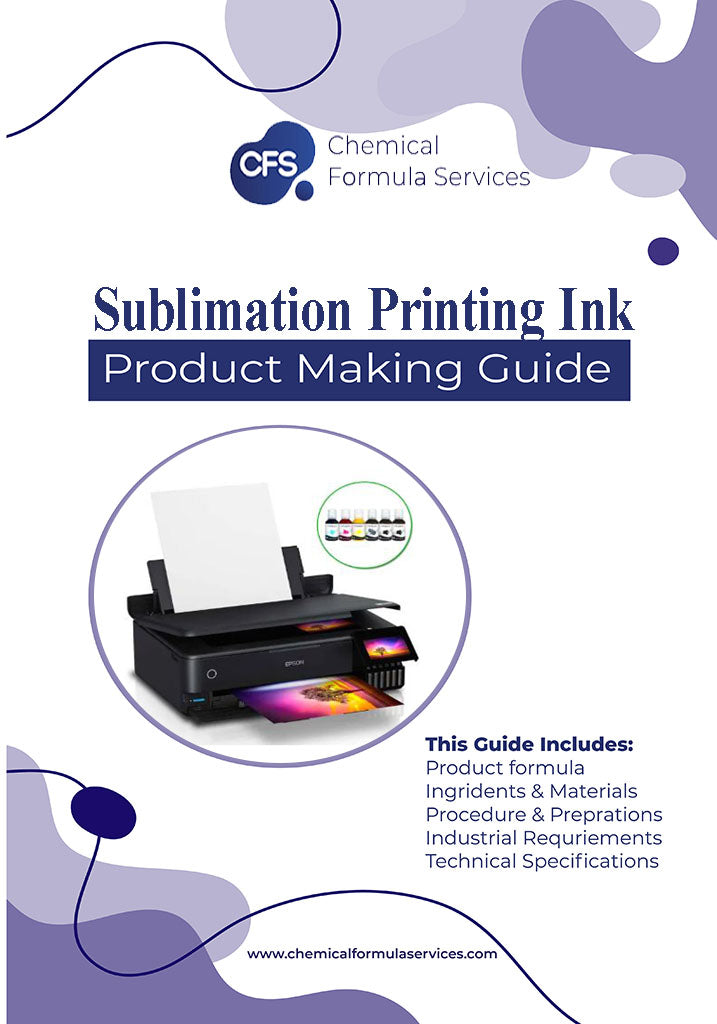
Sublimation Printing Ink Formula
Sublimation Printing Ink Formula
Regular price
$90.00
Regular price
$90.00
Sale price
Unit price
per
Couldn't load pickup availability

Sublimation Printing Ink Formula
Regular price
$90.00
Regular price
$90.00
Sale price
Unit price
per
Sublimation printing ink formula is a specialized type of dye-based ink used in a printing process called dye-sublimation. This process allows the transfer of images onto a variety of substrates, such as fabrics, ceramics, metals, and plastics, through the application of heat and pressure.
\n
View full details
Characteristics of Sublimation Printing Ink Formula
\n-
\n
-
Dye-Based Composition:
\n
-
\n
- Sublimation inks are made from solid dye particles suspended in a liquid solution. These dyes are designed to sublimate, or transition directly from a solid state to a gas state, without passing through a liquid phase when heated. \n
\n -
High Color Vibrancy:
\n
-
\n
- The dyes used in sublimation inks provide vibrant and rich colors, making them ideal for producing high-quality, detailed images. \n
\n -
Heat Activation:
\n
-
\n
- The sublimation process is activated by heat, typically applied using a heat press. The heat causes the dye to sublimate and penetrate the surface of the substrate, resulting in a permanent and durable image. \n
\n -
Substrate Compatibility:
\n
-
\n
- Sublimation inks are primarily used on polyester fabrics and polymer-coated substrates. The dye bonds with the polyester molecules, making the image part of the substrate rather than sitting on top of it. \n
\n
SubilimationÊ Printing Process:
\n-
\n
-
Printing:
\n
-
\n
- The sublimation ink is printed onto a special transfer paper using an inkjet printer designed for sublimation printing. The design is printed in reverse (mirror image) on the transfer paper. \n
\n -
Heat Transfer:
\n
-
\n
- The printed transfer paper is placed on the substrate (e.g., a polyester T-shirt, ceramic mug, metal sheet) with the printed side facing the substrate. \n
- A heat press is used to apply heat and pressure. The typical temperature range is between 350¡F and 400¡F (175¡C to 205¡C), and the time can vary from 30 seconds to a few minutes, depending on the substrate. \n
\n -
Sublimation:
\n
-
\n
- The heat causes the dye on the transfer paper to sublimate and transform into a gas. The gas then permeates the surface of the substrate and bonds with the polyester or polymer coating. \n
\n -
Cooling and Finishing:
\n
-
\n
- Once the transfer process is complete, the substrate is allowed to cool. The result is a vibrant, high-resolution image that is durable, washable, and resistant to fading. \n
\n
Applications :
\n-
\n
-
Textiles:
\n
-
\n
- Custom apparel, such as T-shirts, sportswear, and accessories made from polyester or polyester blends. \n
\n -
Home Decor:
\n
-
\n
- Items such as pillowcases, curtains, and wall art that are made from polyester fabrics. \n
\n -
Promotional Products:
\n
-
\n
- Personalized items like mugs, mouse pads, keychains, and phone cases with polymer coatings. \n
\n -
Signage and Displays:
\n
-
\n
- Fabric banners, flags, and displays for events and trade shows. \n
\n -
Photo Gifts:
\n
-
\n
- Custom photo gifts such as photo panels, puzzles, and ornaments made from polymer-coated materials. \n
\n
Advantages of Sublimation Ink:
\n-
\n
-
Durability:
\n
-
\n
- The images created with sublimation ink are long-lasting and resistant to fading, scratching, and washing. \n
\n -
High-Quality Prints:
\n
-
\n
- Produces high-resolution images with vibrant colors and fine details. \n
\n -
Versatility:
\n
-
\n
- Can be used on a wide range of substrates, allowing for diverse product offerings. \n
\n -
Eco-Friendly:
\n
-
\n
- The process produces minimal waste compared to other printing methods, as there are no inks to clean up and excess materials are not required. \n
\n
Considerations:
\n-
\n
-
Substrate Limitations:
\n
-
\n
- Works best on polyester or polymer-coated surfaces. Natural fibers like cotton are not suitable for sublimation. \n
\n -
Cost of Equipment:
\n
-
\n
- Requires specialized printers and heat presses, which can be an initial investment. \n
\n -
Ink and Paper Compatibility:
\n
-
\n
- The quality of the sublimation ink and transfer paper directly affects the final print quality. \n
\n
-
\n
- Sublimation Ink \n
- Dye Sublimation \n
- Sublimation Transfer \n
- Heat Transfer Printing \n
- Polyester Printing \n
- Sublimation Process \n
- Inkjet Sublimation \n
- Vibrant Colors \n
- Textile Printing \n
- Custom Printing \n
- Heat Press \n
- Sublimation Paper \n
- Sublimation Coating \n
- Digital Printing \n
- Colorfastness \n
Sublimation Printing Ink Formula Guide
\n
\n
\n